
From Old Market to City Hall: Tony Dyer, protest and the politics of power
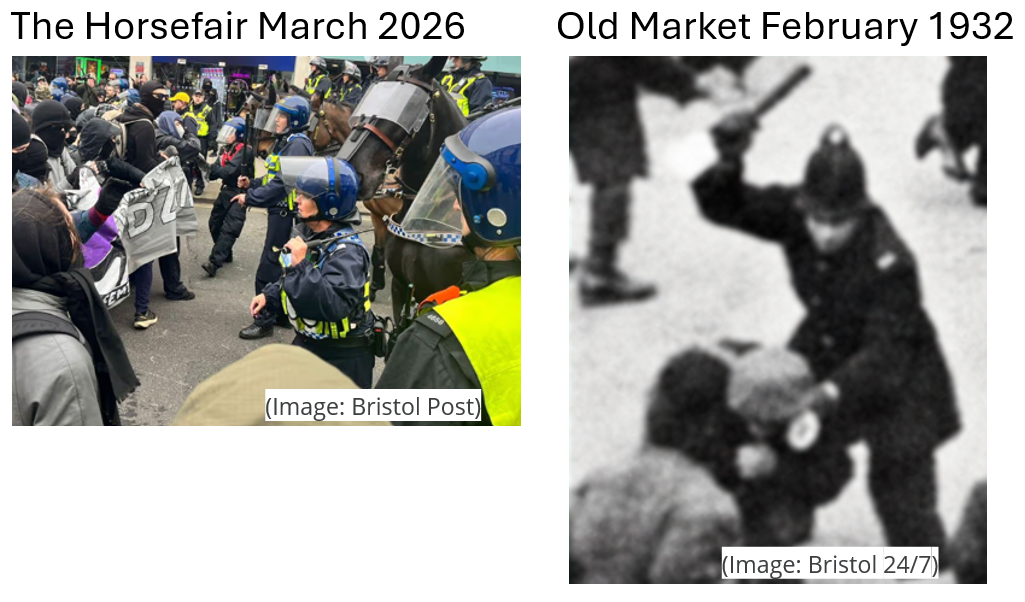
In February 1932, Bristol’s Old Market became the scene of one of the city’s most dramatic confrontations between protesters and police.
Thousands of unemployed people had taken to the streets against cuts to unemployment assistance during the Great Depression. Police attempted to stop the march, batons were drawn, mounted officers were deployed and the demonstration descended into violence.
Among those caught up in the events, according to Bristol council leader Tony Dyer, was his grandfather.
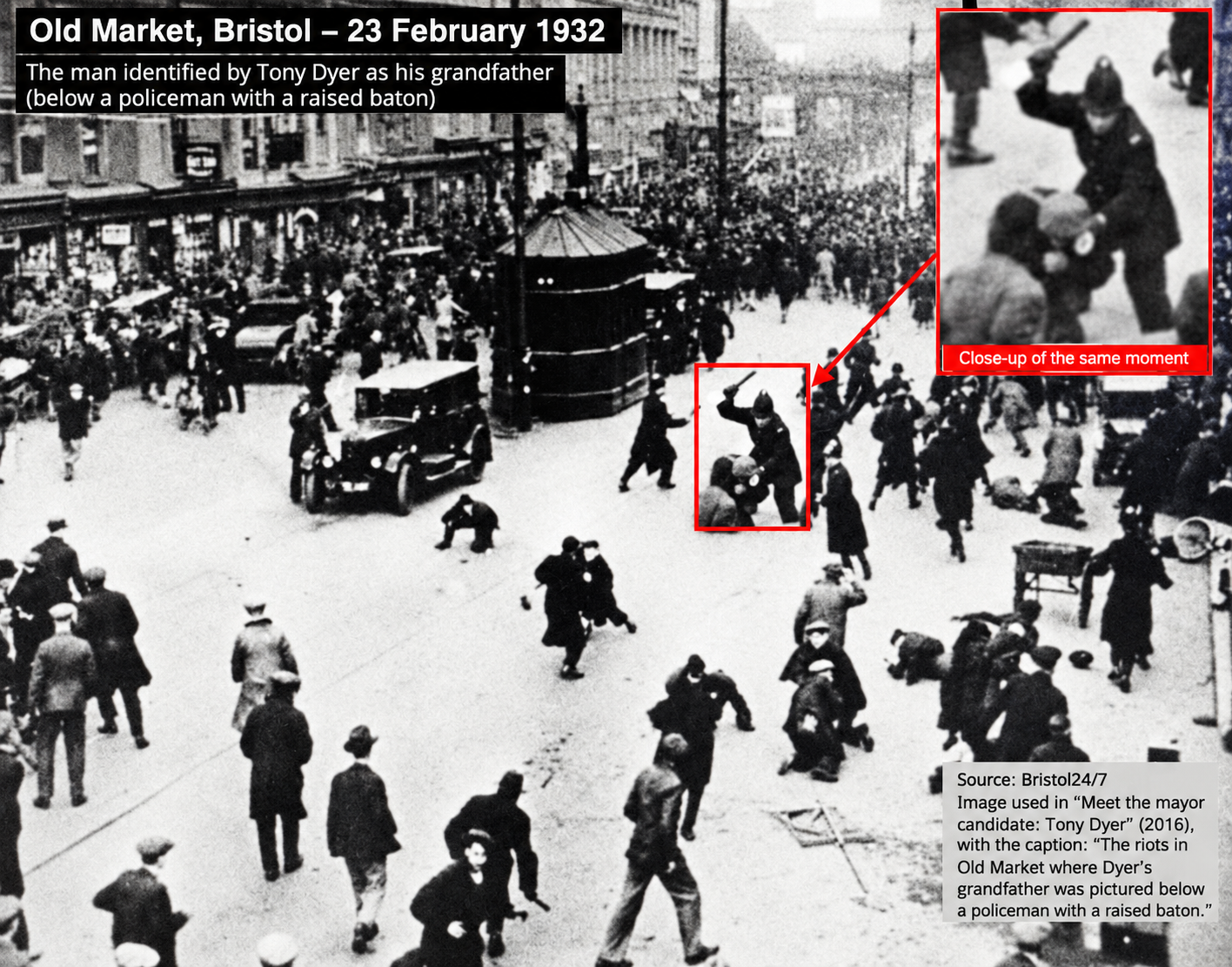
A photograph of the disturbances shows a policeman with a raised baton above a young demonstrator. Dyer has said that the young man was his grandfather, then just 17 years old. (See Bristol 24/7 Article).
More than 90 years later, his grandson occupies a very different position in Bristol’s political life.
Tony Dyer is now leader of Bristol City Council — the building protesters routinely march on when they want decisions changed.
And his comments about modern demonstrations reveal an interesting tension between Bristol’s long tradition of protest and the responsibilities of those who eventually find themselves in power.
“Bread or batons”
The disturbances in Old Market were rooted in mass unemployment.
By early 1932, more than 26,000 people were officially registered as unemployed in Bristol. The National Unemployed Workers’ Movement organised protests against proposed reductions in unemployment assistance and demanded work schemes instead.
On 23 February, thousands gathered for a march despite a police ban.
What followed was a major confrontation.
Police with batons attempted to break up the demonstration, while protesters fought back with whatever objects they could find. Fighting spread through Old Market and surrounding streets.
The photograph above captures the chaos.
Dyer said his grandfather was one of the demonstrators visible beneath a policeman wielding a baton.
The episode is commonly known as the Old Market riots, although Bristol Radical History Group argues that describing them simply as riots risks obscuring their origins as organised political demonstrations against unemployment and benefit cuts. (See Bread or Batons?: The Old Market ‘riots’ - Bristol Radical History Group).
The protests were not entirely unsuccessful.
Bristol City Council subsequently postponed planned reductions in assistance several times during 1932.
A grandson in power
Tony Dyer grew up in Hartcliffe and has frequently spoken about his working-class Bristol roots.
After his involvement in grassroots projects and more than a decade in Bristol Green politics, Tony Dyer was elected as a Southville councillor in 2021 and became council leader three years later.
That has placed him on the opposite side of the City Hall doors from many of Bristol’s modern protest movements.
His attitude towards those protests has not been uniform.
When demonstrations have concerned racism and the far right, Dyer has been an enthusiastic defender of peaceful protest.
Following disorder and counter-demonstrations in Bristol in August 2024, he praised those who had turned out to oppose racism and Islamophobia and commended people who had gone out to peacefully protect vulnerable people.
Similar language followed later far-right demonstrations.
Dyer has said extremist views have “no place in Bristol” and that ignoring racism is “not an option”. (See Bristol City Council Statement)
In those circumstances, protest is presented as an important expression of Bristol’s values.
When the protest is against the council
The language changes when protesters are attempting to stop the council carrying out one of its own policies.
That became particularly apparent during the controversy surrounding the East Bristol Liveable Neighbourhood.
Residents in Barton Hill opposed traffic restrictions and, at times, physically resisted their installation. Police attended while council infrastructure was put in place, creating images strikingly different in political context but reminiscent of Bristol’s long history of confrontation between authorities and protesters.
Dyer subsequently acknowledged that things had gone badly wrong.
He said there were lessons to learn from the way residents had been engaged and publicly expressed regret about the conflict.
But he also drew a line around what he regarded as legitimate protest.
Speaking about the lessons for future liveable neighbourhood schemes, Dyer said:
“We cannot simply just allow those processes to be stopped by undemocratic means.” (See Bristol 24/7 Article)
It is a revealing phrase.
There is an obvious democratic argument behind it. Councillors are elected to make decisions, and governments cannot realistically abandon every policy whenever sufficiently determined opponents physically prevent its implementation.
But it also raises an older question.
When does protest cease to be an exercise of democratic rights and become “undemocratic”?
The uncomfortable historical comparison
The same question could have been asked in Old Market in 1932.
Tony Dyer’s grandfather was not merely writing to his councillor or participating in an official consultation.
He was, according to Dyer’s own account, part of a mass movement attempting to pressure the authorities into reversing a policy decision.
The march had been prohibited.
Protesters nevertheless assembled.
When the authorities attempted to prevent them advancing, the confrontation became physical.
By modern standards, the events would almost certainly be described as serious public disorder.
Yet viewed historically, the protesters’ underlying cause - resisting cuts in support for unemployed people during an economic depression - is likely to attract considerably more sympathy than contemporary official descriptions of disorder might suggest.
Their protest also helped force the issue back onto the political agenda.
That does not mean the Old Market disturbances and modern protests against traffic schemes are equivalent.
The causes, economic circumstances, scale of violence and political context are plainly very different.
But the comparison illustrates something more fundamental about protest.
Those exercising power tend to distinguish between protest they regard as morally justified and protest which frustrates their own decisions.
From protest party to governing party
Dyer himself has acknowledged the transformation.
Discussing the Greens’ position in Bristol after taking control of the council, he remarked:
“We’re no longer a protest party.”
From Interview with Tony Dyer on Bristol Unpacked in May 2025.
That may be one of the most significant sentences for understanding the current Green administration.
For decades, Bristol Greens could campaign against decisions made by Labour, Conservative or Liberal Democrat administrations.
They could stand alongside campaigners, criticise consultations and demand changes from outside the executive machinery of the council.
Now they have to make the decisions.
That means deciding which campaigns should be accommodated, which policies should be changed following opposition, and which decisions should be enforced despite that opposition.
The transition inevitably changes a political party’s relationship with protest.
Bristol's recurring argument
Bristol has an unusually rich history of political demonstration.
The city has seen unemployment marches, trade union protests, anti-war demonstrations, environmental direct action, the toppling of Edward Colston’s statue, Kill the Bill protests, demonstrations over housing, Gaza, asylum seekers, racism and liveable neighbourhoods.
Each generation tends to view some previous protest movements sympathetically while being considerably less comfortable with disruptive protest occurring in the present.
The photograph of Tony Dyer’s grandfather therefore provides more than an interesting piece of family history.
It captures a recurring political dilemma.
In 1932, a young Bristolian stood in Old Market beneath a policeman's raised baton while demanding that those governing the city change course.
Today his grandson helps govern that city.
And when Bristol protesters demand that his administration change course, Tony Dyer has to answer the same question faced by generations of political leaders before him:
At what point does disruptive protest become an illegitimate attempt to overturn democracy — and who gets to decide?
Comments ()