
EBLN Review - Division, Unequal Impacts and Loss of Trust
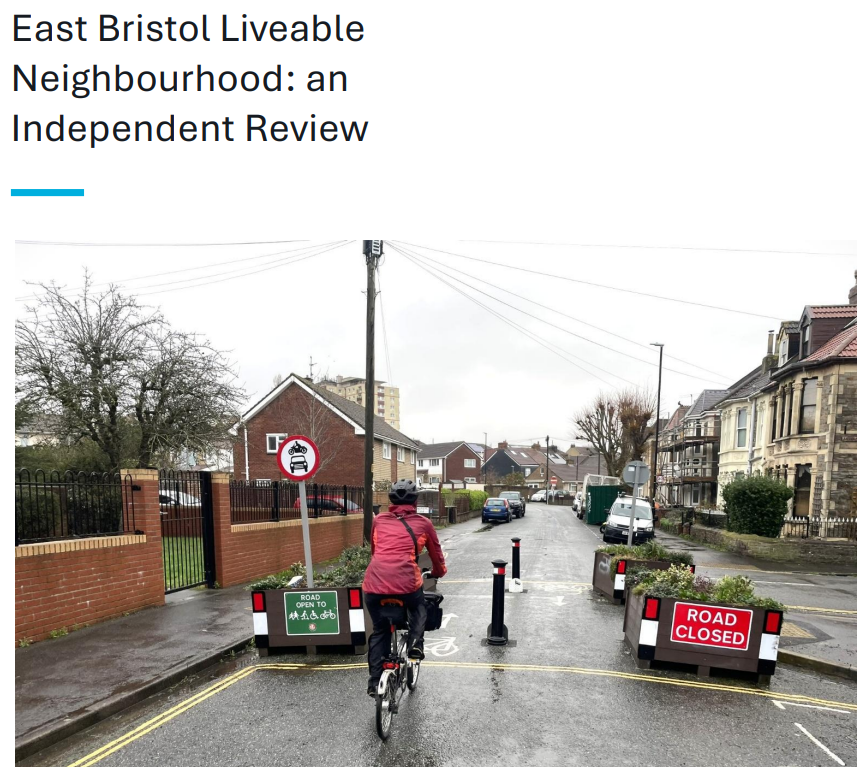
WECA have just published the "East Bristol Liveable Neighbourhood: an Independent Review".
Summary
Independent EBLN review finds traffic reductions — but also division, unequal impacts and loss of trust.
How independent is it?
The Independent Review was produced by Steer Davies & Gleave Ltd.
This review was commissioned by the West of England Combined Authority (WECA) and was undertaken by Steer, using specialist staff who had had no prior involvement in the EBLN scheme and were not previously familiar with the East Bristol area. Guidance and oversight were provided by an Advisory Group of out-of-region academics with relevant expertise to support the independence and quality of the work.
The reviewers themselves were selected to have no prior involvement with EBLN, but their employer, Steer, has been a longstanding transport consultant to Bristol/West of England public bodies for roughly two decades.
For example, in October 2025—only about three months before receiving the EBLN review—WECA awarded Steer another contract to carry out its City Region Sustainable Transport Settlement “Lessons Learnt” commission. (Decision Notice)
WECA also awarded Steer a £60,000 Retrofit West evaluation contract in 2025. (Decision Notice)
As far back as 2007, Steer Davies Gleave produced the Greater Bristol Public Transport Corridor Options Final Report for the West of England Partnership. It subsequently worked on West of England Bus Rapid Transit/MetroBus studies. Those documents were later included as evidence in the Ashton Vale to Temple Meads inquiry.
By 2014 Steer itself described Darren Pacey of Steer as the client project manager for the West of England Ashton Vale to Temple Meads scheme, part of what became MetroBus. Steer said its work covered development of that scheme through planning and preliminary design.
It also produced the 2014 independent review of the MetroWest Phase 1 Preliminary Business Case for the West of England LEP.
Steer then worked with Jacobs on the studies behind the proposed Greater Bristol mass-transit system, including the 2017 pre-feasibility work and later feasibility assessment commissioned through Bristol City Council.
Steer has previously been retained by West of England bodies to act as an independent reviewer while also carrying out other consultancy work for the same regional transport system.
The Review
"East Bristol Liveable Neighbourhood: an Independent Review"
The review of the East Bristol Liveable Neighbourhood (EBLN) is broadly supportive of the scheme’s underlying concept, but much more critical of how it was defined, communicated, implemented and experienced by parts of the community.
Its central conclusion is essentially: the scheme has delivered some of its intended transport effects, but the evidence is still early, some outcomes are mixed, and the social/engagement impacts have been significant.
The Schemes Objectives were relatively generic rather than tailored closely to East Bristol, and the objectives in the Business Case did not always match those in the Monitoring Strategy. Steer says residents should have been involved much earlier in defining the scheme’s objectives and vision.
Residents could influence details of the design, but could not really influence the fundamental decision to introduce a Liveable Neighbourhood based around traffic restrictions. Steer explicitly says that opposition at the conceptual level could not be accommodated because removing the core traffic-management principles would undermine the purpose of the scheme.
Steer describes the evidence as mixed or incomplete for:
- congestion and journey times
- air quality
- perceptions of safety
- high-street footfall
- satisfaction with the area
- equality impacts
Some residents reported quieter and safer streets and improved wellbeing. Others reported:
- greater stress
- longer journeys
- access problems
- social isolation
- negative effects on businesses
Steer says people who have greater mobility, flexibility and access to alternatives appear to have adapted more easily, while some disabled people, lower-income residents, carers, shift workers and businesses have faced greater difficulties.
It says EBLN has:
- been divisive
- attracted significant negative local attention that could make future schemes harder to implement
- produced uneven impacts that run counter to equality objectives
- been associated with reported adverse health effects for some residents
- caused some operational impacts for the Fire Service
SBLN
The Review is supposed to be about the EBLN, but it also references the SBLN.
The review is effectively telling BCC to apply these EBLN lessons to SBLN:
- involve residents earlier in defining the vision and objectives;
- be clearer about what residents can genuinely influence and what has already been decided;
- show more clearly “you said, we did”;
- involve disabled people earlier;
- conduct accessibility work before designs are effectively fixed;
- involve emergency services much earlier;
- collect better baseline traffic, congestion, accessibility and equalities data;
- make engagement more meaningful to avoid the division and loss of trust seen in East Bristol
The message for people who do not want the SBLN is clear. You have no say on whether or not the SBLN is implemented, but you might have some say in how some of the proposals (e.g. Tree Planting) are implemented.
Comments ()