Pointless Consultations - "Not Another One"
In 2017 Brenda from Bristol caught the national mood with her reaction to yet another general election "You're joking - not another one!"
Bristol City Council spend a lot of money on consultations in order to evidence that they are "listening to residents". But it appears that most consultations are a tick box exercise and cannot actually impact the pre-determined outcome.
Take the example of the "Workplace Parking Levy" consultation that was approved this week at the Transport & Connectivity Policy Committee. This was the same meeting where Councillors voted to make the EBLN permanent, after apparently taking into account consultation feedback from residents.
This appears to be the pattern followed for BCC consultations:
BCC Consultation Process
- Decide what you want the outcome to be
- Design a consultation that is most likely to support the desired outcome
- Never include an option that says "Do not proceed with this initiative"
- Collect the minimum amount of objective data to give the impression that "the outcome is supported by the data"
- Portray people who put a lot of time and effort into engaging with the consultation as being "vocal anti groups"
- Portray people who do not engage in the consultation as "the silent majority" who evidence they support the initiative by saying nothing
- Highlight that given the amount of money spent on Business Cases, Data Collection and Consultancy Exercises that it would be a waste of the money already spent (likely to be a six figure sum or more) if the initiative did not continue
- Make some tweaks to the initiative, approve it at a Committee, and say "you have listened"
This process is similar to the one followed by many property developers in Bristol
Planning Consultation Process
- Propose a high rise development for buildings that are higher than the ones you are actually planning to build
- Include commitments to affordable housing
- Respond to public comments by submitting an updated application which shows how the development will actually be a few floors shorter than your original proposal ("we have listened")
- Once planning permission is granted, make an argument that the development is no longer profitable enough and reduce the level of affordable housing commitment
Workplace Levy Consultation
Bristol Councillors have voted to spend £100,000's on a Workplace Levy Consultation.
This consultation is a waste of money and will only tick the box for "Listening to Residents/Businesses".
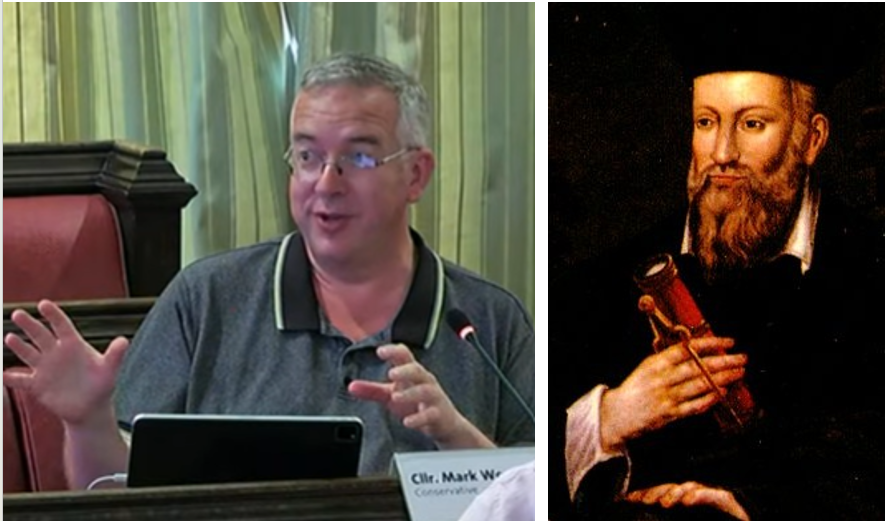
Councillor Mark Weston (aka "Chubby Nostradamus") made this exact point in the meeting.
You are consulting by illustrating option A, E and F. You have picked the worst 2 options (A and F) and once you the consultation is complete, you will say we've listened and we are going to go with E.
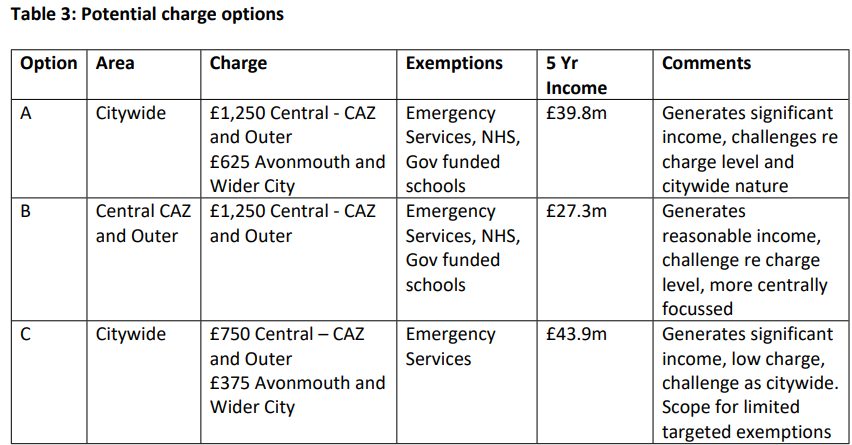
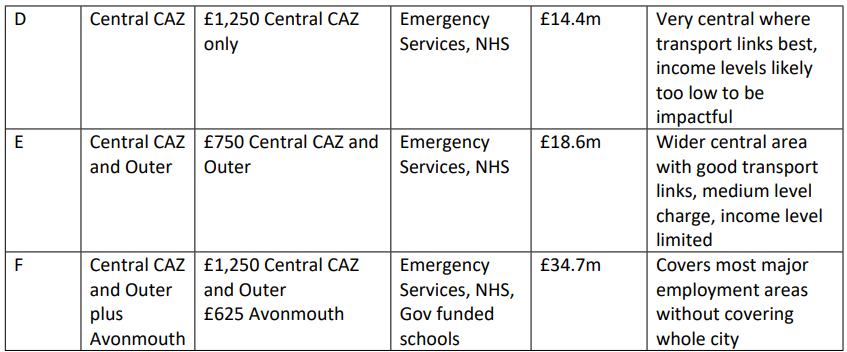
As you can see from the table above, there is no option to "Not Implement a Scheme" and therefore this option will not be consulted on.
The option that Mark Weston has predicted will be chosen (possibly with a few tweaks) is option E:

At £750 per space, this is a lot lower than the £1,250 cost in other options. Although it is still a lot more than the £0 cost of the excluded "Not Implement a Scheme" option.
The "tweaks" are likely to be an increase in the "Exemptions" list that could include Government Funded Schools, Blue Badge Holder spaces, Shift worker spaces and Hospitality worker spaces. But the administration costs of a more complex exemptions list are likely to rise from the estimated 5% "overhead" cost.
Note the income levels need further refinement and will likely reduce by up to 5% to account for scheme overheads.
Option E estimates revenue of £3,720,000 a year which will be reduced by the estimated overheads of £186,000 per year.
What will the revenue be used for?
At the council meeting there was consensus that the revenue from the scheme could not be used as a general "slush fund" in the same way that income from the Clear Air Zone has been used, and had to result in a transformational change in public transport. A Bristol Council takeover of bus services was presented as the type of "transformation" that should be offered as a "carrot" to reduce negative concerns about the "stick" elements of the scheme.
But it is clear that £3.7 million a year will not be enough money to result in a public sector takeover of bus services in Bristol.
What about the Equality Impact Assessment?
The EIA was published in the committee papers.
The Committee Report outlines Bristol City Council’s proposed approach to developing a Workplace Parking Levy (WPL) scheme and associated Outline Business Case. A WPL is an annual charge paid to the Local Transport Authority by employers on the workplace parking spaces they provide. Employers have the option to pass this cost on to their employees or pay the charge themselves. The aim is to encourage employers to manage the number of workplace parking spaces they provide, whilst promoting and encouraging the use of sustainable transport
Where certain equality groups may rely more on driving to work due to accessibility or safety barriers on public transport, this impact may be partially mitigated through investment in public transport infrastructure improvements.
The scheme is likely to have an impact on a significant number of commuters who drive to work and of that group it is not unreasonable to suggest that people on lower incomes will likely find it harder to meet additional costs if their employer passes the cost of the WPL scheme on to them.
The analysis finds that older people make up a greater proportion of people who travel to work by car and therefore they are more likely to be impacted by the scheme than other groups.
Whilst a levy would be for the employer not the employee, there is a strong possibility that charges would be passed on directly to employees or the overall number of car parking spaces reduced - so impacts below have been assessed on that basis.
Disabled people who hold Blue Badges are likely to be exempt, but Disabled employees without a badge and those with mobility needs could still be affected if parking is reduced. Night and shift workers, who often rely on cars due to limited public transport at unsocial hours, may also face disproportionate impacts.
In the council’s cumulative equality impact assessment for the 2025-26 Budget, we recognise that increased charges and levies could disproportionately affect small businesses and the local voluntary and community sector. This impact is especially significant for organisations led by or supporting equality groups, as higher costs may prevent smaller providers from continuing to offer equitable services to Bristol’s diverse population.
As part of the feasibility study, we will evaluate potential indirect impacts on specific users and assess whether discretionary concessions for voluntary and community sector or equality-led stakeholders are appropriate and feasible. A previous scoping study identified that concessions could be made for specific groups, such as blue badge holders, small businesses, and NHS facilities etc.
Analysis at this stage is limited to consideration of the direct impact of a levy on employees and has not considered any potential additional pressure on on-street parking, as the levy would apply to the parking space itself rather than the vehicle. The project plan includes a study to identify any potential displaced commuter parking.
Cardiff Council Consultation
Cardiff City Council also plan to carry out a consultation about a possible Workplace Parking Levy scheme.
But their consultation is looking a many different options to raise money for public transport improvements which include "congestion charging". The council preference is for a workplace parking levy scheme instead of a CAZ type scheme.
This appears to be a more sensible approach to consultation as it allows people to give their views on which type of scheme they would prefer and is a more joined-up approach.
Bristol already have a CAZ scheme and are going to impose a Workplace Parking Levy scheme in addition to the existing CAZ. This is partly because the CAZ scheme income was never ring-fenced for public transport improvements, which means they need an additional scheme to deliver public transport improvements.
Perhaps BCC should only implement a Workplace Parking Levy scheme once the CAZ has been shut down.
Comments ()